Life After Lipo + Tummy Tuck: The $hit No One Talks About-Part 4

If you missed them…
Part 1
Part 2
Part 3

New Grief? Who dis…

The grief and regret were kind of unexpected.

Because how do you say, “Some days I wish I hadn’t done it,” when you made the decision with full intention? When it wasn’t coming from hate or desperation — but from empowerment?

Here’s the truth: I don’t actually know if I’d go back and change it.
Sometimes the thought crosses my mind, but I also know I’m exactly where I’m meant to be.
I would not be who I am, where I am without any of what has transpired over the last four years.

It’s not that I hate my post-surgery body.
It just feels unfamiliar sometimes — and I miss the ease of feeling at home in my own skin.

When the “shelf” shows up or I feel that weird tightness, I’ll literally think,

“Damn… I miss tucking in Felicia and moving on with my day.”

And yet — I know that version of my body wasn’t built to last.
Not because of the loose skin, but because it was sustained by “healthy lifestyle” rules that were really diet culture in disguise.

When I was in it, I lived in this weird in-between space.
I wasn’t chasing my old body anymore, but I also hadn’t made peace with this new one yet.
Some days, the regret of that hit hard.

What made it even harder was feeling like I shouldn’t feel that way.
Like, “You chose this. You don’t get to complain.”
Or, “You coach other women on body image — how can you still be struggling?”

The guilt of still having thoughts.
The shame of still caring sometimes.
The mental ping-pong of “you should be over this by now.”
Yeah. That part.

But what I’ve learned since then is that regret doesn’t mean you did something wrong.
It’s just your brain’s way of replaying the past through the lens of what you know now.
(And this is where the reminder of: “You made the best decision you could with the information you had” stays tucked away in my back pocket.)

And guilt thrives in silence.
So I started talking about it — letting it breathe instead of burying it.

The truth is, I wasn’t just feeling regret.

I was grieving too.
Grieving my old body.
But here is the crazy thing - the body I was missing was a body held together by rules, programs and constant restriction - not my natural body. It wasn’t really the body I would eventually want to live in for the rest of my life (once I realized diet culture wasn’t for me) - it was the body I’d been taught to want.

That was part of the healing too.
Not resisting the hard emotions. Not pretending all is well on the body image front when it’s not.
Just naming it. Letting it breathe. (And now it feels healing to share it all.)

Until I allowed myself to move through this and process it, I could not see ANY of this for what it was — I was blind to it.

Once I slowed down enough to really look at it, I could finally see the full picture.

The stress, grief, and yes — some of my own habits — played a role in all of this. The late-night snacking, the extra wine, the constantly trying to feel better. I wasn’t broken; I was coping.

But I also can’t ignore that the surgery itself changed my body — the structure, the fat distribution, the way it responds now. It’s part of the equation too.
Some of what I experienced was just biology doing its thing; some of it was life, stress, and healing colliding all at once.

Once I stopped making myself wrong for it and got curious instead, I could finally slow down, listen, and meet myself with compassion again.

And truthfully, I’ll never know what my body would’ve done without the surgery, the move, or the shifts from perimenopause. Maybe it would’ve changed anyway. Maybe this was always part of the path.

Either way, this work — learning to meet my body with awareness and compassion — was inevitable. Bodies change. Seasons change. The only constant is that I choose to show up for myself through it.
Life After Lipo + Tummy Tuck: The $hit No One Talks About-Part 3

If you missed them…
Part 1
Part 2

When Your “After” Doesn’t Feel Like You Anymore


Let's move on, shall we?

So yeah, I had the surgery. A day before my 38th birthday!

My IG page has a TT Highlight for more - also be warned, there are graphic images.

I had Felicia the Flap removed (may she RIP).

And I had lipo on the sides of my hips and along my ribcage, where my bra band sits.
I recovered like a rockstar. (Keep in mind, I did not have an ab repair, which I hear is brutal.)

Meanwhile, Aaron had started a new a position with Apple - a dream job (at the time) that meant a cross country move - that was intended to be permanent.

So in July of 2021, just a few months post surgery, we set off for a new adventure.
New city. New routines.
Stress. Grief. All the things.

And within a few months… I gained 13 pounds.


Let me be clear:
This IS NOT about the number on the scale.
It’s about what that weight gain did to my body after surgery — and how sometimes, becoming a new version of yourself means doing work you thought you’d already done.

Suddenly, clothes fit differently.
Shirts pulled in weird places.
My back looked like a whole new shape.
(Insert “fat guy in a little coat” visual here. Humor keeps me sane.)

And the shelf. Ohhhh, the shelf.

March 2022 - I can also confirm that once my body reset back to its natural weight - the shelf still shelfs.

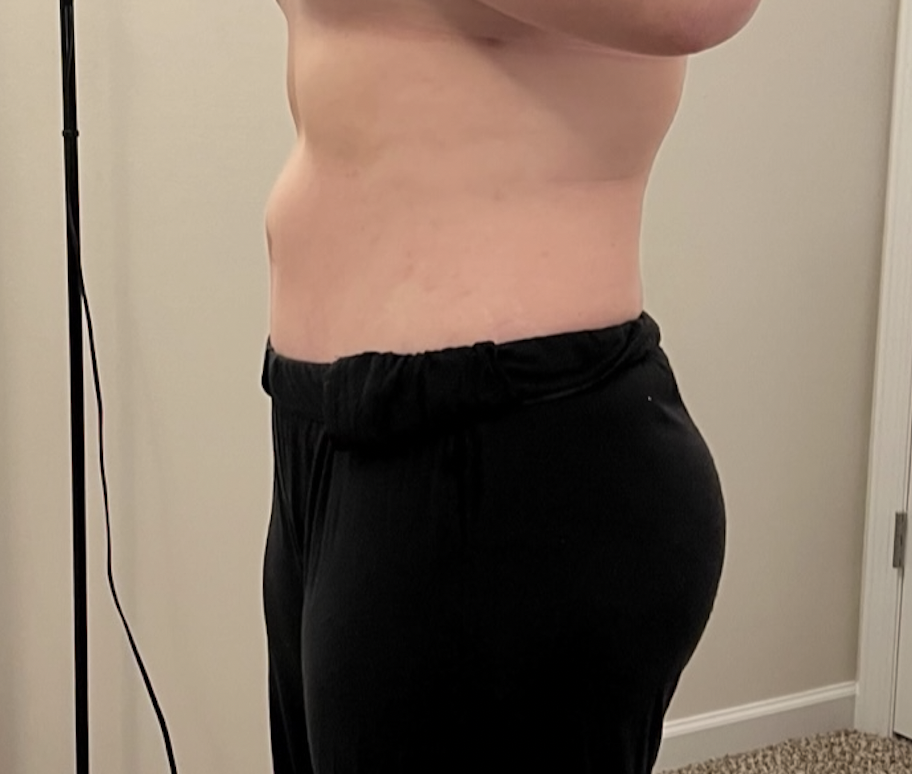
There’s this upper belly “shelf” that pops up now when I bloat? Yeah, she’s the unexpected roommate that moved in rent-free after surgery.

I loved my doc, she is actually great, pretty honest and I felt comfortable with her from the first moment I met her - but her reply didn't give me hope:

"If weight gain occurs then all patients get full in that spot!!!"

It also came with an offer for lipo in that spot if I could not lose weight on my own - which, at that point, I hadn’t fully ditched diet culture yet.

So of course, my brain went straight back to: okay, maybe I should “clean it up” again.

But the truth was, this weight gain didn’t need another diet to “fix” itself.
It was a mix of cortisol spikes, grief, and exploring a new city with lots of meals out (aka overeating + overdrinking and living life).

But here’s the real the kicker no one tells you:
When fat cells are removed, they grow back in new places.
They can’t return where they were taken from — so they just set up camp somewhere else.
Which explained why many parts of my body started to feel foreign to me.

And that’s when the real discomfort set in.
Not because I hated my body (ok, I did kind of dislike my body most days) but mostly because I didn’t feel physically comfortable in it.
And I didn’t know how to fix that without falling back into the old patterns I was trying to leave behind.

I didn’t want to diet again.
But I did want to feel at home in my body — to move, dress, and exist without constant awareness of how everything felt different.
That tension — wanting comfort without control — became its own kind of healing work.

Side Note:
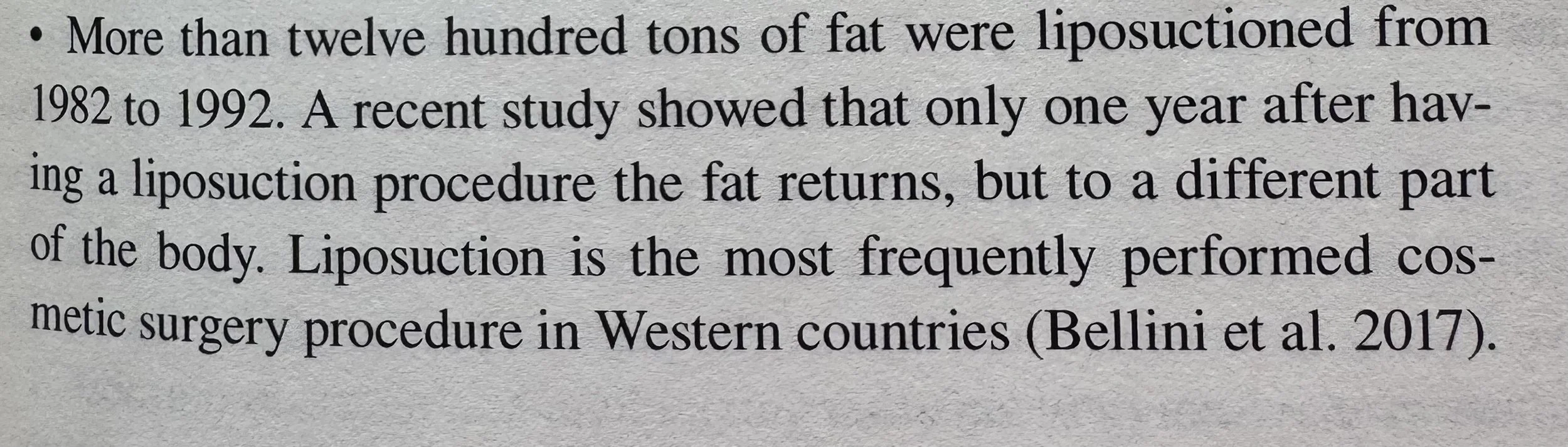
Reading Intuitive Eating later confirmed what we assumed - that the procedures can definitely change your body comp - Aaron also found other research, posted below.

This is an excerpt from Intuitive Eating: A Revolutionary Anti-Diet Approach that I stumbled upon when reading it - which solidified research Aaron had also been doing himself on the topic. See end of blog post for additional article and research.

At this point in the timeline, I wasn’t fully out of diet culture, but I was dipping my toe into what I thought was mindful eating — and some days throwing all caution to the wind and eating whatever the f I wanted (which, I’ve learned, is part of the process of reconnecting with your body).

I was somewhere between I am done dieting and I don't know what this mindful eating shit really means...but I’m figuring it out.

I tried to stay calm.
I ran bloodwork. Saw a functional doctor.
Tried to make “healthier” choices.

She wanted me to eat paleo - that was a no for me dawg.
So I tried to bring the containers back, cut back on dairy and gluten (wellness culture...IYKYK), but still not completely depriving myself like before.
I lost some weight.

But this isn’t about how I looked or a number on the scale. It was these “unexplained” changes in my body—how it felt.There’s this strange physical discomfort that comes from removing parts of your body at one size and then gaining weight; it creates a tightness, a pulling. Some days I felt so miserable I just wanted to put on compression shorts and lie down. (This still happens if I overeat or eat something that doesn’t sit well with my body and end up bloated.)

Even with all my awareness and self-compassion tools, the old thoughts crept in.
“How did I let myself go?”
“Why can’t I get it together again?”

I wasn’t prepared for it—emotionally, mentally, or physically. I didn’t want to diet again, but I did want to feel comfortable in my skin. I wanted to understand what was happening, not fix it. And that tension—wanting relief without restriction—became its own kind of work.

I thought the hard part was behind me after surgery.
Turns out, it was just the beginning of a new kind of work.

But here’s what I learned from that version of me:

  • She was doing her best — navigating grief, stress, and massive change all at once. Her body was reacting exactly how bodies do in those seasons.

  • She taught me new things about my body — what it needs, how it communicates, and how to listen.

  • She showed me how to have more compassion for myself through body-image disruptions. It didn’t happen overnight, but she got me there.

It didn’t mean the work I’d done failed.
It just meant I was entering a new chapter — one that required new tools, new awareness, and a whole lot more grace.

For a long time, I didn’t feel like I could talk about it. I’d chosen this surgery from a healthy, empowered place — so when my body changed afterward, it felt like something no one wanted to hear about. Like it didn’t count as a valid struggle.

And if you’re reading this and nodding because you’ve had a similar experience, or felt betrayed by a body you thought you understood… you’re not broken. You’re just human.

Whether it’s surgery, perimenopause, stress, or just life doing its thing — our bodies are always changing. What matters most is how we respond when they do.

PS – It’s okay to want to feel good in your body. But every body is different. We each have a natural place where our body feels its best — and that spot usually lives somewhere in the middle. Not in deprivation or overindulgence, not in chasing a certain size, but in that balance where you can live your life and still feel at home in your skin.

In the next post, I’ll share the grief and regert that followed…


Here are articles and studies on lipo, for any interested.

Article: With lipo, the fat comes back — in weird places - this article uses the following study as reference:
Fat redistribution following suction lipectomy: defense of body fat and patterns of restoration


And one more share if you want to watch here - this is a 4 minute clip of Bunnie, Jelly Roll’s wife talking about her experience with a BBL (Brazilian butt lift, for those who don't know) and her experience is VERY similar to mine.

"Your body completely changes. It changes the chemistry of your body."

I do want to say, there is some messaging I don’t love - when she talks about weight and size - but that is okay because I can hear that and not let it impact me or my thoughts about my weight or size, but if it is a trigger for you - skip it!

Life After Lipo + Tummy Tuck: The $hit No One Talks About - Part 2

If you missed it: Part 1

And before I dive into Part 2 — if you want, you can catch up on my realization that I had totally drank the diet culture Kool-Aid here. But you don’t need to read that to follow along with this story. It’s just a good post about how I spent years knee-deep in dieting before finally seeing it for what it was.

From 2015 to 2021, my life was basically doing programs, eating out of portion-control containers, and coaching other women through the same thing. But honestly, the best part — no joke — was learning the power of doing things for my future self, becoming aware of my self-talk, questioning the stories I told myself, and realizing I had the power to change them. That’s the work that evolved into the coach I am today.


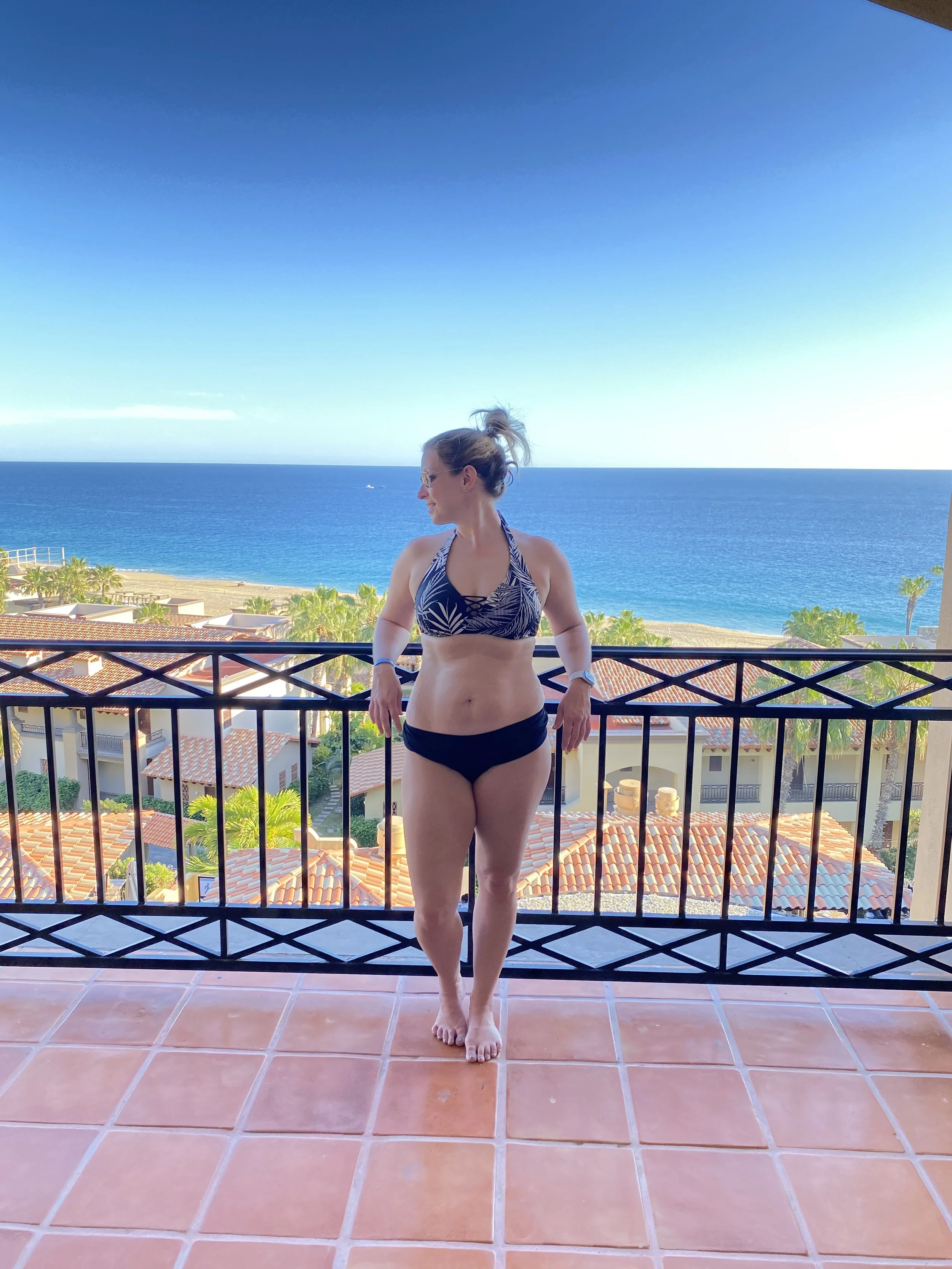
Jan 2021, pre surgery

Or..start here!

The body I accepted wasn’t my natural body — it was my diet body.

In 2021, I made the decision to have a tummy tuck and liposuction.
Not because I hated my body.
Not because I wanted to “fix” myself.
And definitely not because I felt pressure from anyone else.

I had actually done the work.
I was in a good place with my body.
I had accepted the stretch marks, the mom sag (Felicia the Flap, may she RIP).
I had found peace with it all.

But I was also curious.

I was in a season of life where I was wondering, “What’s next?”
I felt strong. Confident. In my skin, in my workouts, in my life.

And surgery felt like a next-level step—not a desperate one.
I wanted to see what was possible.
It came from a place of empowerment, not punishment.

I scheduled the consult, feeling a mix of fear (because this surgery is no joke) and excitement for what was to come.

When you meet with a doc, they talk to you about your weight - are you at a manageable weight? Do you plan to lose more? Has this been a steady spot for you? Etc.

And when my doc asked me if I was done losing weight, I said yes.
Because I genuinely believed I was.
I had maintained that size for a while. It felt like my “set point.”
I didn't think I was yo-yo dieting.
I didn't think I was restricting hardcore.
I thought I had finally found my groove.

But here’s what I couldn't see at the time:

The “groove” I was in was still being held together by diet culture.

I wasn’t fully free from the "just one more program" mindset.

I wasn’t doing programs in a punishing way—but I was still chasing progress, still eating in a calorie deficit often enough to stay that size.
Not because I was purposely depriving myself, but because I’d been taught that doing these programs this way was just “healthy.”
That maintenance required vigilance. That this was just how women “stayed fit.”

(Side note: There was RARELY living in maintenance as a coach because when you got to maintenance, you gained weight - so you did another program, lowered your food bracket...aka: the cycle.)

In retrospect - it's like my job as a coach was to be a constant before and after, to show a program worked. I didn’t realize that what I had normalized was actually restriction in disguise.

Couple the woman and coach I am today with everything I’ve learned about intuitive eating, body respect, and how deeply diet culture can root itself into your habits - I can now see that the body I thought I had accepted wasn’t my real body. It was my diet body.

But at the time I was doing the best I could with what I knew.
The surgery wasn’t punishing myself. It wasn’t chasing a fix.
I was just loving the body I had—and making a choice that felt good for me.

And it did feel really good…until it didn’t.

Because when the way you’re maintaining your body isn’t sustainable, any changes—like surgery (or even a cross-country move)—can bring a whole lot of unexpected outcomes.

Once I stopped living in a deficit, my body finally had a chance to recalibrate. And what followed was some unexpected shit.

That’s what I’ll get into in Part 3-how my body changed, what I wasn’t prepared for, and how it shifted the inner work I had to do.

PS - if you are following along, I’d love to hear from you - come let me know over on IG, @ashleylmolitor


BONUS: 8 Sneaky Signs You’re Still Stuck in Diet Culture

Check in to see if diet culture has a grip on you in your life - let’s be real even when you think you’ve ditched diet culture, those sneaky little thoughts (habits) have a way of sliding back in - like when you go to eat fries after already having rice and know you want to have a glass of wine later and you hear Autumn in your ear telling you “that is too many yellows.” IYKYK.

So before you beat yourself up for having a “diet” thought or a bad body image day — pause and check in with yourself.

Here are a few signs you might still be tangled up in diet culture mentality (no shame, just awareness):

  1. You label foods as “good” or “bad.”
    Cupcakes leave you all guilty but a salad earns you a gold star…

  2. You think about what you “should” eat more than what you want or need.
    “Should” is diet culture’s favorite word. Learning to listen to your own body is a practice after years of following rules.

  3. You tie your worth (or your day’s success) to how you ate or moved.
    Your value doesn’t fluctuate based on your calories burned or what you ate for dinner.

  4. You avoid social events because of the food.
    If you’re skipping birthdays or brunches because you’re scared to “mess up,” that’s not freedom—it’s disconnection. Diet culture has made food the main character instead of the people and moments you actually want to enjoy.

  5. You feel like you have to “earn” or “burn off” your food.
    Food is fuel, not a debt to be repaid.

  6. You compare your body to your past self or others and call it “motivation.”
    That kind of “motivation” usually just breeds shame and frustration.

  7. You chase the next “healthy lifestyle” trend that promises to fix you.
    If it’s just dieting with prettier packaging (hello, “wellness resets”), it’s still diet culture.

  8. You struggle to trust yourself around food.
    If you think, “I can’t buy that, I’ll eat the whole thing,” that’s not lack of willpower—it’s a sign diet rules have overridden your self-trust.

Breaking free from diet culture isn’t about perfection—it’s about awareness.
Every time you notice one of these patterns, you take your power back.
That’s the work.
That’s how you heal your relationship with food, your body, and ultimately… yourself.


Disclaimer: This is not medical advice - these are signs to look for that diet culture is still engrained in your daily habits - if you find yourself struggling with more serious food or exercise related issues - please seek help with an eating disorder specialist.

Life After Lipo + Tummy Tuck: The $hit No One Talks About - Part 1

We’re kicking this series off with an intro — a summary of what’s to come, if you will.
$hit I Haven't Talked About Post Tummy Tuck + Lipo.

I’ve shared small pieces of this story on social, but it’s time for the full version — not to convince anyone to do (or not do) what I did, but simply to tell the truth about what it’s been like for me.

Two reasons I’m sharing this:
1. To help anyone make a more informed decision. (I’m putting together a list of questions to help you get clarity if surgery is something on your mind—it’ll drop with the last post of this series.)
2. Because I’m typically an open book, and I’ve gone through some highs and lows with my body over the last few years that I haven’t fully talked about. I had shared on social about these struggles in small doses. But now that I’ve had time to process and reflect, I’m ready to write it all out.

I’ll admit, there were layers of shame built into not talking about it more openly as it was happening.

Shame that my body has changed so much since 2021.
Shame that I still have body image disruptions.
Shame that I coach women on self-acceptance and still have days where I want to crawl out of my own damn skin.

(FYI: Self-acceptance doesn’t mean you love your body every day—it means you don’t abandon yourself on the days you don’t.)

But that’s the thing about shame—it grows in silence.

As Brené Brown says:

“If you put shame in a Petri dish, it needs three things to grow exponentially: secrecy, silence, and judgment. If you put the same amount in a Petri dish and douse it with empathy, it can’t survive.
The two most powerful words when we’re in struggle: me too.”

A lot of my shame came from believing that because I’m a coach who helps women work on self-acceptance, I shouldn’t have my own body thoughts.
That I shouldn’t have struggled with my emotions when life got hard and my body changed.
That I shouldn’t have gained weight after being at my “ideal” weight when I had surgery.

So much “shoulding” all over myself — “shoulding” I would never let a client or friend do to themselves.

But here’s what I know now: going through this didn’t make me less of a coach — it made me a better one.

When I first started coaching, I thought doing “the work” meant those hard thoughts would eventually disappear, replaced with shiny new ones — no shitty thoughts ever again. HAHA.
But I quickly learned that is not the point.

Coaching doesn’t erase the thoughts — it gives you the awareness and tools to meet them with compassion instead of judgment.

Different seasons of life bring up old stories in new ways, and that’s not failure. That’s being human.
And the more I’ve learned to show up for myself in those moments, the more I can help my clients do the same — to see that nothing’s wrong with them when the thoughts pop back up, when they have an off body-image day, or when they feel like they’ve lost progress.

We’re not broken. We’re just learning to meet ourselves differently.

So in sharing my story, I'm hoping to give shame less room to grow. Don't get me wrong - there may be a vulnerability hangover that comes from this series - but I'm just gonna let that be what it is...


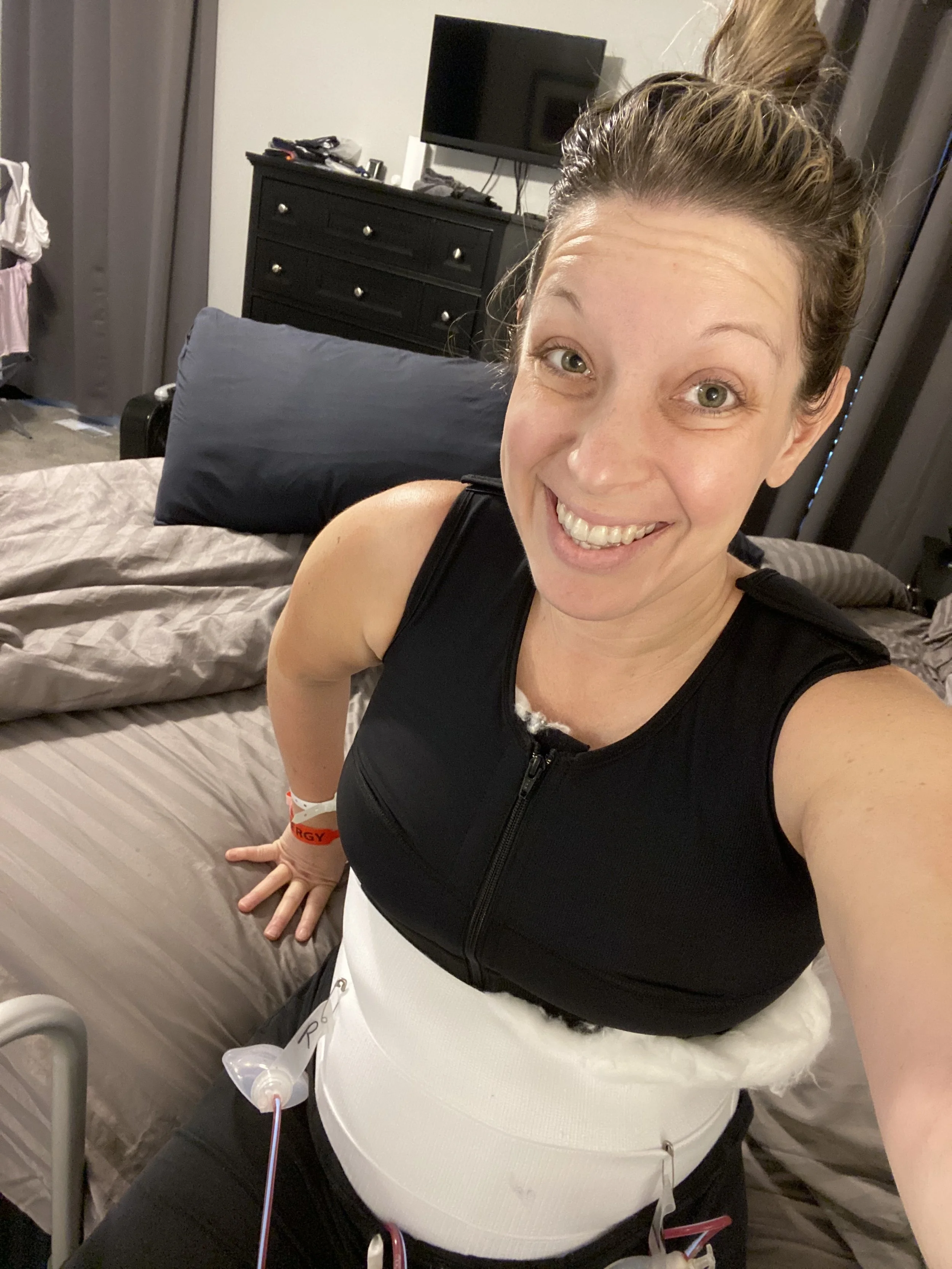
Morning of: 4/12/21

When I had my surgery in 2021, I thought I was in full body acceptance.
But the truth is, the body I had accepted wasn’t my real body—it was my diet body.

Smaller. Controlled. Kept that way by years of programs and portion containers and calorie counting disguised as “healthy.”

When I finally broke up with diet culture, started mindful eating, and stopped living in a constant deficit, my real body showed up.
And it was different.

That didn’t mean the old work failed.
It meant I had entered a new season with new triggers and new lessons waiting for me.
Healing doesn’t erase the hard moments—it just gives you the tools to face them differently.

Here’s how it all unfolded:

  • 2015: Became a coach through an MLM focused on dieting + workout programs

  • April 2021: Tummy tuck + liposuction

  • July 2021: Cross-country move

  • January 2022: Moved back home

  • 2022–2023: Started breaking up with diet culture, dabbling in mindful eating

  • Late 2023–2024: Began practicing intuitive eating more consistently

So yeah… my body has changed a lot in that time.
And it’s been harder to re-accept it than I ever expected.

The old thoughts crept in a lot during that season.
The shame unpacked her bags.
And sometimes, I let her stay longer than I should.

But each version of me has taught me something new—and this one’s no different.

This version of me is learning to live what I teach - that growth isn’t linear, that awareness doesn’t erase the hard parts, and that you can accept yourself even on the days it still feels hard — hold compassion for yourself when the old thoughts show up — and know that you can hold both acceptance and growth at the same time.
(AND is a powerful word in acceptance)

Diet culture was like a toxic relationship I didn’t realize I was in.
I had accepted the body that constant dieting created—mom sag and all—and even made peace with my loose skin.
But when I finally broke up with diet culture, everything shifted.
It took me down a new path of self-acceptance I didn’t see coming.

This isn’t a before-and-after story.
Those days are long gone.
It’s not a transformation tied up with a pretty bow — it’s the continuation of the work.

Over the next few posts, I’ll share:
→ Why I chose surgery
→ What happened after
→ The things I didn’t expect
→ The grief and regret I wasn’t prepared for
→ And how I’m learning to accept my body as it is

I’m sharing this for me—and for anyone who’s ever felt lost in their own skin.

(Oh and to keep it even more real, peri-menopause has been adding a whole new twist but that is for another blog series, another time. LOL.)

My Future Self: Winter Edition

Last year, I noticed a pattern after winter.

During the dreaded “W” season, Aaron and I get a little more sedentary — nothing crazy — just more nights on the couch (binging our favorite shows), an extra cocktail or two midweek, and more snacking “because it’s cold and dark.”

And honestly, what the fuck else do we have to do? LOL.

It’s not a problem… until it starts to be. By late winter, I can feel it — I’m sluggish (outside of my usual self-diagnosed SAD) and a little out of sync with my natural day-to-day flow.

It’s like I slowly trade intentionality for autopilot.

But this year, I’m doing it differently, bitches!
I’m planning ahead with my Future Self in mind.
Zero judgement, I’m just getting honest about it. Awareness is key!

While past me hates the cold and boredom of winter, buffers with snacks, shows, and cocktails — which leaves her with more blah energy and less alignment with how she wants to feel. A.K.A. I buffer my winter blues and boredom away.

Future me has it figured out.

So, in an effort to not recreate “past me” - I’ve jumped ahead, pictured myself in March, pictured my Future Self — clear-headed and ready for spring — and I asked her:
What would YOU thank me for this winter for?
What routines would support YOUR energy?
How would YOU spend evenings without reaching for wine and dip?

And she always answers with the best advice…
She says things like:

“Thanks for not making cocktails a weeknight habit.”
“Thanks for choosing connection and creativity instead of buffering away your boredom and winter blues.”

When my brain says, “Eh, one more cocktail won’t hurt,” my future self says:
“Your future self enjoys a Thursday or Friday night cocktail — let’s save it for then and make it special.”

When my brain says, “It’s dark, might as well grab the dip,” she says:
“Tuesday doesn’t need to be party food night. Let’s make something cozy that still feels good. We can have a planned dip night this weekend!”

She’s not about restriction — she’s about intention.
She doesn’t deprive herself, but she also doesn’t overeat or overdrink to get through winter.

Let’s be honest —a good portion of us use food or a cocktail (or even endless scrolling) to manage our boredom or lack of activities in winter.
It’s dark, it’s cold, and sometimes the highlight of the day is what’s for dinner or what’s in the glass (or what’s online).

Side Note: This isn’t about weight loss. Once I share my tummy tuck blog post, this will make even more sense — but I’ve learned through research and personal experience that my body has a natural weight where it loves to hang out. That natural weight isn’t the version of me who’s overeating or overdrinking — she’s the version who lives her life without restriction but also without buffering.

And honestly, that’s exactly how I help my clients too. We don’t overhaul their diets or obsess over calorie deficits. We look at where they might be overeating, overdrinking, eating their feels, or stuck in diet cycles — restricting during the week, then going ham on the weekends — and instead, we work on mindful, sustainable choices that feel good long-term.

Because when you stop buffering or spinning in the “diet cycle” - you naturally land closer to your body’s happy place —your natural weight.


I’ve learned that buffering — snacking, sipping, zoning out — doesn’t actually make me feel better. It just gets me to spring like, ‘Cool, I made it… but I also feel like ass and slept like shit for 3 months.’

This year, I’m thinking of both versions of me:

  • My future self in spring who’ll thank me for not buffering.

  • And the current version of me (in winter) who wants to feel more alive and less sluggish.

Instead of reaching for a snack or another drink because there’s ‘nothing else to do,’ I’m asking: What do I really need in this moment? Or what choice can I make now that will positively impact how I show up tomorrow?

Sometimes it’s a walk, a puzzle, or tea instead of wine. She knows she can feel bored and let it be — or find things that lift her up instead of adding to the blah.

If I can set Winter Me up with that kind of love and care, I know Spring Me is going to feel so damn proud.

If you want to try this too, here are a few prompts from my own journal this week:

  • What does she choose instead on weeknights that still feels fun or comforting?

  • What routines help her enjoy being inside during winter instead of resenting it?

  • What would feel good for her mind + in her body come spring-what supports that now

Because here’s the thing — if you’re not connected to the future version of yourself, even just a few months out, you’re way more likely to make decisions that only feel good in the moment.

You’ll reach for that instant gratification or dopamine hit — the extra drink, the snack, the scroll — but that’s exactly what gets us to the next season asking, “How the fuck did I get here?!”

So I’m not waiting for spring to feel better.
I’m becoming her now — by visualizing what winter looks like for her, and choosing, one cozy, intentional moment at a time.