Things I’m Not Doing This Thanksgiving: Blasting My Husband on Facebook

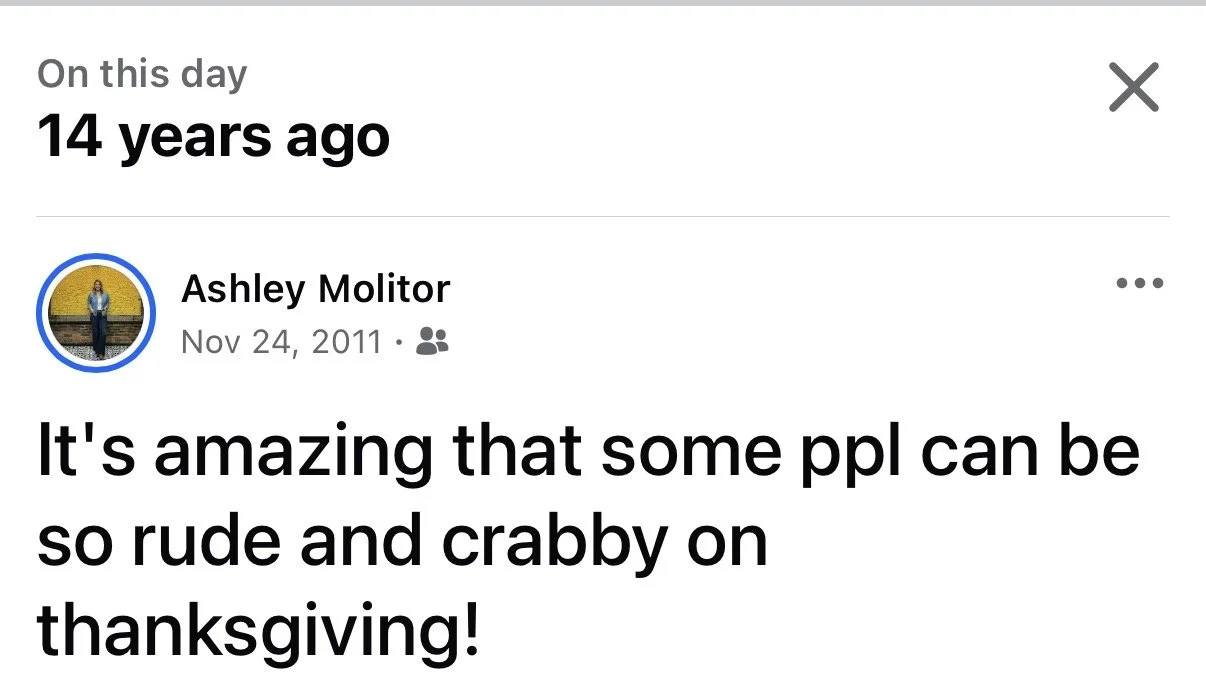
Found this little gem in my FB memories. Oof.

Apparently, 14 years ago passive-aggressive Facebook updates were basically my personality.

Actually, a lot of my posts before coaching came into my life had this same tone. Whether it was about Aaron, my job, or anything else outside of me I thought “was the problem.”

But I don’t post stuff like this on social media because I don’t live in that headspace anymore.

I do my best to not make it my job to manage someone else’s emotions and not blame other people for how I feel. (I'm human. Not perfect.)

But either way, I’m definitely not blasting my husband on socials on Thanksgiving anymore.

Coaching changed that part of me.
It taught me how to stop reacting to everything and start taking my power back.

At the time of this post, we were so lost in our marriage and didn’t even realize it…
Little moments like this added up-thinking the other persons mood was our problem to fix or taking their mood personally which led to resentment and petty arguments.


We weren’t bad people. We just didn’t know how to be humans with feelings instead of passive-aggressive assholes to each other.

Both unaware of it all. Both reactive. Both giving our power away to the other.

The game changed when I finally saw I wasn't just "reacting to him".

...I was reacting to my own expectations of him. My thoughts about him. Pair that with unregulated emotions and my inability to let him have his own feelings without wanting them to be different...phew. What a freaking recipe.

This is literally how that day played out:

Me: "He is so crabby and rude."
→ I'd feel irritated AF.
→ Then l'd get snappy.
→ And boom... now I'm the one being crabby.

All because I was uncomfortable with his mood and thought he should fix it. And the irony of me thinking he should fix his shit mood while creating a shit mood for myself-classic.

But now I can actually see that pattern. That's the awareness coaching gave me.

We've both changed SO MUCH since then. Not because some miracle happened, but because we had to learn how to communicate, take ownership, and stop letting our unmanaged mind and moods run our marriage.

We had to learn how to communicate, take ownership, and stop letting our unmanaged mind and moods run our marriage.

I share this because so many women I coach are in this exact place; resentful, exhausted, carrying everything, reacting instead of choosing, and feeling like the victim in their life (while maybe even showing up like the villain, yet unaware of it).

It doesn’t have to stay like that.

And if you’ve ever caught yourself posting something like this (or thinking it), spinning in your head about everything your partner does, or feeling like you’re carrying the emotional weight of the entire relationship…

You’re not alone, and you’re not broken-you’re just stuck in patterns you didn’t even realize you were in.

Give yourself the gift of awareness.

Notice when you’re trying to manage your partner’s emotions instead of your own.

Then ask yourself:
“Is this mine to carry?”
“What can I actually control here?”
…and maybe notice what YOU create when you take on their mood.

That’s the beginning. That’s the shift.
You can take your power back in your relationship.

I mean, I’m definitely proof you can unf*ck your mindset and your marriage.
Why We Keep Doing Holiday Traditions That Don’t Fit Anymore (and How to Change That)

For the moms trying to keep every holiday tradition alive — here’s your reminder that the holidays get to be yours too.

If you’ve ever gone through a holiday season on autopilot — doing all the things because that’s just what we do — you’re not alone.

We bake the cookies, send the cards (although I dropped this one years ago…for me, that felt aligned & damn good), overfill the calendar, and keep traditions alive that maybe don’t even light us up anymore.

We do it out of habit, guilt, or pressure — not always out of joy.

And while we love the memories those traditions once created, sometimes they just don’t fit this version of our life anymore.

But why, Ashley?! Why do we keep doing this to ourselves?!

We fall into what I call holiday autopilot.
It’s that mix of nostalgia, obligation, and fear of disappointing others.
We tell ourselves:

  • “It’s what my family expects.”

  • “My kids will be sad if we don’t.”

  • “It’s just easier to do it than deal with the guilt.”

And you question none of those thoughts.

But here’s the truth: you’re an adult now — with your own family, your own season of life, and your own priorities.
What used to work might not fit anymore, and that’s okay.

Allow me to Give You Permission to Choose What Fits Now

You’re allowed to create new memories and traditions that fit you — not just repeat the ones you grew up with or keep saying yes to everyone else because you think you have to.

You get to decide what actually feels right for your family this year.
And that might look quieter, simpler, or completely different from what you grew up with.
That doesn’t make it less meaningful — it makes it yours.

A Personal Example: Redefining “Tradition”

A few years ago, we realized we didn’t even like traditional holiday meals.
Every Thanksgiving we’d cook all the things we were “supposed” to — turkey, stuffing, casseroles — and by the end of the day, we were exhausted, stuffed, and honestly… feeling like complete ass.

So we changed it.

Now, our Thanksgiving spread is full of finger foods — things we actually enjoy eating and don’t feel miserable afterward. The pressure’s gone, and for us, it’s fun.

And for Christmas Eve, we ditched the stress of cooking altogether. We all get dressed up, go out to eat, and enjoy the slow pace of the evening instead of rushing around the kitchen.

And no one misses the old way. We leave dinner satisfied from a good meal, happy, and not chained to dishes or a food coma for the rest of our night.

That’s what it means to make the holidays yours.

Check In: Here are a few questions to help you reflect on what you truly want this season to look like:

  • If no one expected anything from you this year, what parts of the holidays would you actually still choose to do?

  • Am I doing this because it feels good and aligns with what matters to me — or because I’d feel guilty if I didn’t?

  • What memories and feelings do I want my kids to grow up remembering — and how do I want to show up for them this season?

Listen — if there are things you love and want to carry on, amazing.
But if there are things you’re doing out of pressure, guilt, or habit, it’s okay to let them go and make space for what feels right for you.

You don’t need permission from anyone else.
But if you need a reminder — this is it.

If you read this blog post, you’re here for a reason,, take it as your sign to give yourself permission to let go of the pressure, set some boundaries, and take your power back this holiday season.

Come find me on IG, I will be talking all things that will help you create a calm, connected, and intentional holiday season.


If this is something you struggle with in your day to day life, if you are feeling overwhelmed and like you are constantly overbook, overwhelmed and flying by the seat of your pants - I got you - getting clear on where your priorities lie, being able to say no out of alignment with what matters most to you and what you value is the perfect thing to bring to coaching. 1:1 spots are open.

Life After Lipo + Tummy Tuck: The $hit No One Talks About-Part 5

If you missed them…
Part 1
Part 2
Part 3
Part 4

The Finale…Ok, not really - but you get it.

There’s this assumption that once you’ve done the work — once you’ve healed your relationship with your body — everything just clicks.
That you’ll never have another bad body-image day, or that confidence becomes some permanent state you live in.

But that hasn’t been my experience.

This whole story — everything I’ve shared up to now — has really been about the middle.
The space between healing and finding a way to feel at home again.
The season where some days I felt strong, confident, capable… and other days I stood in my closet ready to cry because nothing felt right.

It was the season of grieving clothes that used to fit just right.
Of watching my body shift again, even after I thought I had “fixed” it.
Of fighting the urge to diet — not to shrink, but to escape the discomfort.
Because when your body feels foreign, it’s easy to start believing the old stories again.

But that season also taught me something powerful, instead of tearing myself apart…
I can choose compassion over punishment.
I can speak to myself the way I tell my clients to.
I can practice kindness when my brain says, “Start over.”
I can buy new clothes that feel great.

This is about me reclaiming my body—not by changing it, but by changing the way I respond to it.
And it’s a practice.

Body acceptance isn’t a destination. Especially in the society + culture we live in…
It’s not a light switch you flip after reading a few affirmations.
It’s a relationship. There are triggers.
And like every relationship—it needs attention, patience, and a hell of a lot of grace.

Here’s what I did that helped me heal through this:

There was a point in the last 4 years where I almost slipped back into that old pattern—trying to “fix” my body from a place of lack (“I’m broken” thinking.)

But deep down, I knew that wasn’t where my healing started. I’d made the decision for surgery from a place of empowerment, not lack, so I reminded myself of that —of what it feels like to take action from love, not desperation. From acceptance, not control.

And I used that same energy to move forward through this season, too.

  • Went shopping. Picked out new outfits that fit this season of life, focusing on how they made me feel.

  • Let hard body-image days exist without turning them into a shame spiral.

  • Reminded myself that this version of me—whatever size, shape, or season—is still worthy of love, attention, and respect. (And when I can’t find that for myself, I have Aaron, friends, or my coach to help remind me.)

  • Trusted that I don’t have to go back to “before” to feel like me again.

And when the thoughts creep in—as they still do—I remind myself: I don’t have to love my body every day to respect it. I can, in fact, have a shitty body-image day and still show up for myself— those are the days it matters most.

No matter where you are in your own story, here’s what I’ve learned:

  • Body image disruptions will happen. Even when you’ve done “the work.” Even when you think you’re past it. That doesn’t mean you’ve failed — it means you’re human.

  • Your body’s gonna keep changing — stress, hormones, kids, aging, life... all of it. Trying to control every little shift will drive you nuts. The goal isn’t control; it’s learning to stay connected to yourself through it.

  • Compassion always works better than control. Every time I meet myself with curiosity instead of criticism, the healing sticks a little longer.

  • You can make peace without pretending. Acceptance doesn’t mean you love every inch 24/7; it means you don’t abandon yourself when the old stories get loud.

  • The goal isn’t to chase “self love.” It’s learning to stick with yourself through the hard days — the way you’d show up for someone you actually give a shit about.

Looking back, this whole journey wasn’t about surgery or size — it was about awareness.
About seeing the stories I’d carried, the rules I’d outgrown, and the versions of myself I had to meet with compassion instead of criticism.

From breaking up with diet culture to rebuilding trust with my body — to realizing I could still struggle and still be okay — every part of it mattered.

It all led me here:
To a relationship with my body that’s realistic - which isn’t free from random struggles, but I’m also no longer chasing someone else’s ideal.

Because reclaiming my body was never about changing how it looked —
it was about finally changing how I see myself.

Maybe that’s what reclaiming really is—
not having all the answers, just refusing to abandon yourself while you figure it out.

Edited to add: I had an appt this morning after sharing this series and it reminded me that recently (as in the last 6 months) - I discovered that surgery can affect how your body functions as well. I’ve since discovered with my pelvic floor PT that some of my pelvic-floor dysfunction and bladder leakage we are working to correct are more than likely related to the tummy tuck — it created a disconnect between my breath, core engagement, and pelvic floor. It’s not something people talk about much, but it’s real — and it’s been part of my healing, too.


BONUS:

Change isn’t the problem.
It’s why you want it and how you’re approaching it that matters.
When you’re grounded in your “why,” and it’s coming from abundance — from love, curiosity, or wanting to feel more like yourself — change can be powerful.
But when it’s coming from lack, comparison, or pressure to “fix” something, it usually creates more noise, not peace.

So before you make a decision (whether it’s surgery, a new diet, or anything else that promises a “better” you), check in with yourself using these questions below.


Questions to Help You Get Honest About Your “Why”

Mindset Awareness Questions
Is your decision coming from empowerment or from old diet-culture stories - these can help you gain clarity.

  1. What’s motivating me to want surgery right now — comfort, confidence, comparison, or something else?

  2. Am I hoping this will change how I feel about myself, or simply how I look?

  3. If my body never looked any different after this, what emotion would I be left with?

  4. What am I expecting to feel once I’ve healed — peace, pride, relief, control?

  5. Have I tried to create any of those feelings without changing my body first?

  6. How do I talk to myself about my body right now — with kindness or criticism?

  7. What part of my body image struggle is actually about me, and what part came from what I was taught to believe about “good” bodies?

  8. Who do I imagine judging me (or praising me) if I do this?

  9. What story do I think this surgery will let me rewrite?

  10. Am I ready for the mental and emotional recovery that comes with the physical recovery?

Diet-Culture Awareness Questions
These questions will help you uncover whether the decision is being made from restriction, comparison, or external validation.

  1. Am I currently tracking calories, macros, or portion sizes to “earn” this body?

  2. Do I feel anxious when I eat certain foods or take a rest day?

  3. Do I use the scale to decide if I’m “good” or “bad” that day?

  4. Have I been chasing a “before and after” moment instead of long-term peace?

  5. When I picture my “ideal body,” does she look like me — or like a filtered version of me?

  6. Have I ever thought, “Once I get surgery, I’ll finally stay on track”?

  7. Do I believe smaller automatically means healthier or happier?

  8. Could I be open to wherever my natural body settles if it meant total food freedom and peace?

  9. Would I still want surgery if nobody ever saw the results?

  10. Do I feel like my worth would change if my body didn’t?

Final Reflection Prompt

What would it look like to make this decision from love and acceptance instead of fear or fixing?

Life After Lipo + Tummy Tuck: The $hit No One Talks About-Part 4

If you missed them…
Part 1
Part 2
Part 3

New Grief? Who dis…

The grief and regret were kind of unexpected.

Because how do you say, “Some days I wish I hadn’t done it,” when you made the decision with full intention? When it wasn’t coming from hate or desperation — but from empowerment?

Here’s the truth: I don’t actually know if I’d go back and change it.
Sometimes the thought crosses my mind, but I also know I’m exactly where I’m meant to be.
I would not be who I am, where I am without any of what has transpired over the last four years.

It’s not that I hate my post-surgery body.
It just feels unfamiliar sometimes — and I miss the ease of feeling at home in my own skin.

When the “shelf” shows up or I feel that weird tightness, I’ll literally think,

“Damn… I miss tucking in Felicia and moving on with my day.”

And yet — I know that version of my body wasn’t built to last.
Not because of the loose skin, but because it was sustained by “healthy lifestyle” rules that were really diet culture in disguise.

When I was in it, I lived in this weird in-between space.
I wasn’t chasing my old body anymore, but I also hadn’t made peace with this new one yet.
Some days, the regret of that hit hard.

What made it even harder was feeling like I shouldn’t feel that way.
Like, “You chose this. You don’t get to complain.”
Or, “You coach other women on body image — how can you still be struggling?”

The guilt of still having thoughts.
The shame of still caring sometimes.
The mental ping-pong of “you should be over this by now.”
Yeah. That part.

But what I’ve learned since then is that regret doesn’t mean you did something wrong.
It’s just your brain’s way of replaying the past through the lens of what you know now.
(And this is where the reminder of: “You made the best decision you could with the information you had” stays tucked away in my back pocket.)

And guilt thrives in silence.
So I started talking about it — letting it breathe instead of burying it.

The truth is, I wasn’t just feeling regret.

I was grieving too.
Grieving my old body.
But here is the crazy thing - the body I was missing was a body held together by rules, programs and constant restriction - not my natural body. It wasn’t really the body I would eventually want to live in for the rest of my life (once I realized diet culture wasn’t for me) - it was the body I’d been taught to want.

That was part of the healing too.
Not resisting the hard emotions. Not pretending all is well on the body image front when it’s not.
Just naming it. Letting it breathe. (And now it feels healing to share it all.)

Until I allowed myself to move through this and process it, I could not see ANY of this for what it was — I was blind to it.

Once I slowed down enough to really look at it, I could finally see the full picture.

The stress, grief, and yes — some of my own habits — played a role in all of this. The late-night snacking, the extra wine, the constantly trying to feel better. I wasn’t broken; I was coping.

But I also can’t ignore that the surgery itself changed my body — the structure, the fat distribution, the way it responds now. It’s part of the equation too.
Some of what I experienced was just biology doing its thing; some of it was life, stress, and healing colliding all at once.

Once I stopped making myself wrong for it and got curious instead, I could finally slow down, listen, and meet myself with compassion again.

And truthfully, I’ll never know what my body would’ve done without the surgery, the move, or the shifts from perimenopause. Maybe it would’ve changed anyway. Maybe this was always part of the path.

Either way, this work — learning to meet my body with awareness and compassion — was inevitable. Bodies change. Seasons change. The only constant is that I choose to show up for myself through it.